5 min read
FIRE Planning in the Era of Job Losses
Financial independence is harder to plan for when a steady job is no longer guaranteed. Here is how to build a resilient strategy for a shifting market.
#FIRE#finance#career#strategy
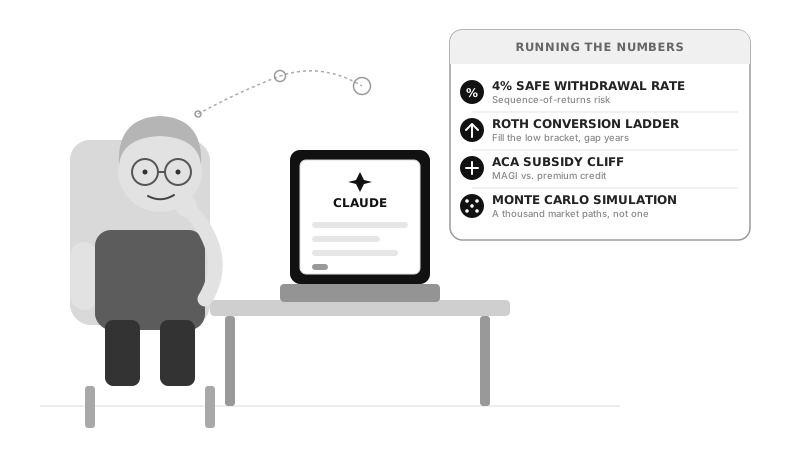
I've written before about FIRE for the tech worker and what happens to the plan when the job disappears. Both there is always more to it, the part nobody really likes: actually running the numbers. If you're anywhere near FIRE, or actively on the journey, you know the terms by heart. Safe withdrawal rates, Roth conversion sequencing, ACA subsidy math etc. Unfortunately, these aren't problems you can simply drop into a spreadsheet template and click a button to solve it. They're 'walk me through your assumptions until I trust them' problems. And that's exactly where I've found AI helpful.
A word of caution: AI is not a replacement of human advisor. Thinl of it as a research partner that never gets tired of your fifth follow-up question about marginal tax brackets and chrges additionall fee per hours of Q&A sessions.
FIRE calculators hand you a number. They don't explain why that number moved when you changed one assumption, and they sure don't walk you through what happens when three variables collide at once, like how a Roth conversion this year affects your ACA subsidy next year. That's a conversation, not an online form to fill.
Claude and ChatGPT ( other LLMs as well, but I've tried only these two)is good at exactly that kind of thing. It can hold several moving pieces in its head at once, show you its work, and adjust when you push back on something. It's also surprisingly good at turning a vague worry, like 'am I saving enough?', into a question you can actually answer: 'Given $2.1M invested, an 80/20 stock/bond split, and $85K annual spend, what's my failure rate at a 3.5% withdrawal rate under a 2000-2002 sequence-of-returns shock?' Claude will ask the clarifying questions you didn't know you needed to ask yourself.
What it's not good at: getting 2026 tax law right without you checking. More on that below.
The 4% rule comes from the Trinity Study, a specific 30-year, US-market dataset. Retire at 45 with a 50-year horizon and some international exposure, and the rule starts creaking. Claude can walk you through the historical sequence-of-returns failures instead of just handing you a headline number.
I have $2.1M invested (80% VTI, 20% bonds), spend $85K/year, and plan to retire at 45. Walk me through how a 3.5% vs. 4% withdrawal rate performs under (1) average historical US returns and (2) a 2000-2002-style sequence shock in the first five years. Where do standard FIRE calculators disagree with each other, and why?
Ask it to write and run a quick Monte Carlo simulation in Python if you'd rather see a distribution than two point estimates. Claude can generate that code directly and reason through the output with you. You can even upload your actual Vanguard or Fidelity CSV export and ask it to compute your real blended expense ratio and asset allocation instead of guessing.
This is where AI-assisted FIRE planning pays for itself fastest. If you retire before 59½, you've got a window where your income is near zero and your tax bracket has never been lower, exactly the right moment to move traditional 401(k) money into Roth at a discount.
I'll have $0 W-2 income starting January 2027 and $1.8M in a traditional 401(k). Walk me through a Roth conversion ladder that fills the 12% bracket each year, accounting for the 2027 standard deduction. Show me the five-year plan and flag where a bigger conversion would push me into the next bracket.
Claude is genuinely strong at this layered math, standard deductions, bracket thresholds, the five-year Roth conversion waiting period before penalty-free withdrawal. What it's weaker at is knowing the exact 2027 IRS bracket thresholds with certainty, since it can't be sure its training cutoff still matches this year's inflation-adjusted numbers. Ask it to show its source assumptions, then verify the actual figures against IRS.gov or your tax software before you file anything.
This is the one FIRE bloggers consistently undersell. I mentioned in the tech worker post that losing employer health coverage is the American FIRE wildcard, and the reason is subtler than 'insurance is expensive.' Your ACA premium tax credit depends on your Modified Adjusted Gross Income, which means your Roth conversion decision and your health insurance bill are literally the same decision. Convert too much in a given year and you can lose thousands in subsidies, sometimes more than the conversion saved you in taxes.
My family of four lives in Austin, TX. Estimate my ACA premium tax credit for a Silver plan at $45K, $60K, and $75K MAGI. At what income does the subsidy slope make an additional dollar of Roth conversion not worth it, and how does that change if the enhanced subsidies from the American Rescue Plan extension expire?
This is exactly the kind of multi-variable optimization a static calculator can't handle, because it depends on your state's marketplace, your household size, and a policy detail that's shifted twice in five years. Claude can reason through the current rules with you and tell you which year-specific numbers to double-check.
If you're doing this regularly, don't start from scratch each time. Set up a Claude Project, or a Claude Code skill if you're comfortable with that workflow, with your actual numbers, account balances, cost basis, state of residence, and target retirement date saved as reference. Then every conversation starts from your real situation instead of a hypothetical, and you can ask quick, specific questions:
Given my saved numbers, if I convert an extra $10K this year, what happens to my ACA subsidy and total tax bill combined?
That combined-cost framing, tax plus lost subsidy, is the number that actually matters, and it's rarely the one people optimize for.
Claude can model scenarios and explain mechanisms better than most FIRE calculators. It cannot replace a CPA who signs your return, a fee-only fiduciary who's liable for the advice, or IRS.gov as the source of truth on current-year numbers. Treat every dollar figure it gives you as 'verify this,' not 'file this.' The value isn't in the final number, it's in understanding why the number moves, which makes you a much better client when you do sit down with a professional.
This is not financial or tax advice. Verify all figures with a fee-only fiduciary advisor and a CPA before acting. August 2026.
Financial independence is harder to plan for when a steady job is no longer guaranteed. Here is how to build a resilient strategy for a shifting market.
You earn more than almost anyone. Your equity just vested. The layoffs are real. Here's why Financial Independence isn't just possible for you, it might be more urgent than you think.
Anthropic just launched Managed Agents — a suite of composable APIs for building and deploying cloud-hosted agents at scale. Here's what it means for developers.